Zara

Zara

Project

Service design project that integrates digital touchpoints into the Zara store experience to reduce friction and create a more seamless shopping journey. By combining physical and digital interactions, the solution enhances customer engagement, improves navigation, and streamlines key moments throughout the in-store experience, creating a more intuitive and connected retail journey.

Project

Service design project that integrates digital touchpoints into the Zara store

experience to reduce friction and create a more seamless shopping journey.

Industria

Moda Retail
Phygital experience
Transformación digital

en retail

Industria

Moda Retail
Phygital experience
Transformación digital en retail

Rol

Ux Researcher
Ux/Ui Designer
Service Designer

Rol

Ux Researcher
Ux/Ui Designer
Service Designer

your name here
your name here

Problem

Despite Zara’s success as a global retail leader, in-store shopping can be affected by friction points such as inventory uncertainty, staff dependency, and waiting times. These interruptions impact the customer journey, reducing efficiency and overall conversion.

Challenge

Redesign Zara’s in-store shopping experience by reducing operational friction throughout the customer journey. The goal was to create a more seamless and efficient experience by improving product discoverability, increasing stock visibility, and minimizing wait times across key touchpoints.

Duration & Methodology

Week

1

Desk Research

Show more

Week

2

User research interviews

Show more

Week

4

Customer Journey

Show more

Week

5

Service Blueprint

Show more

Week

5

Definition and concept development

Show more

Week

6

Design proposal

your name here
your name here

Problem

Despite Zara’s success as a global retail leader, in-store shopping can be affected by friction points such as inventory uncertainty, staff dependency, and waiting times. These interruptions impact the customer journey, reducing efficiency and overall conversion.

Challenge

Redesign Zara’s in-store shopping experience by reducing operational friction throughout the customer journey. The goal was to create a more seamless and efficient experience by improving product discoverability, increasing stock visibility, and minimizing wait times across key touchpoints.

Duration & Methodology

Week

1

Desk Research

Show more

Week

2

User research interviews

Show more

Week

4

Customer Journey

Show more

Week

5

Service Blueprint

Show more

Week

5

Definition and concept development

Show more

Week

6

Design proposal

your name here
your name here

Problem

Despite Zara’s success as a global retail leader, in-store shopping can be affected by friction points such as inventory uncertainty, staff dependency, and waiting times. These interruptions impact the customer journey, reducing efficiency and overall conversion.

Challenge

Redesign Zara’s in-store shopping experience by reducing operational friction throughout the customer journey. The goal was to create a more seamless and efficient experience by improving product discoverability, increasing stock visibility, and minimizing wait times across key touchpoints.

Duration & Methodology

Week

1

Desk Research

Show more

Week

2

User research interviews

Show more

Week

4

Customer Journey

Show more

Week

5

Service Blueprint

Show more

Week

5

Definition and concept development

Show more

Week

6

Design proposal

your name here

Problem

Despite Zara’s success as a global retail leader, in-store shopping can be affected by friction points such as inventory uncertainty, staff dependency, and waiting times. These interruptions impact the customer journey, reducing efficiency and overall conversion.

Challenge

Redesign Zara’s in-store shopping experience by reducing operational friction throughout the customer journey. The goal was to create a more seamless and efficient experience by improving product discoverability, increasing stock visibility, and minimizing wait times across key touchpoints.

Duration & Methodology

Week

1

Desk Research

Show more

Week

2

User research interviews

Show more

Week

4

Customer Journey

Show more

Week

5

Service Blueprint

Show more

Week

5

Definition and concept development

Show more

Week

6

Design proposal

USER INTERVIEWS

Understanding Zara experiences first hand

To better understand the in-store shopping experience at Zara, I conducted interviews with both customers and store employees, capturing perspectives from frequent shoppers as well as retail staff involved in daily operations.

Carla Palacios, Client

Carlos Perez, Client

María Suarez, Employee

“The store is disorganized and waste time "

“There are always long queues at the fitting rooms.

“It takes up a lot of my time to locate the items that customers request.”

USER INTERVIEWS

Understanding Zara experiences first hand

To better understand the in-store shopping experience at Zara, I conducted interviews with both customers and store employees, capturing perspectives from frequent shoppers as well as retail staff involved in daily operations.

Carla Palacios, Client

Carlos Perez, Client

María Suarez, Employee

“The store is disorganized and waste time "

“There are always long queues at the fitting rooms.

“It takes up a lot of my time to locate the items that customers request.”

USER INTERVIEWS

Understanding Zara experiences first hand

To better understand the in-store shopping experience at Zara, I conducted interviews with both customers and store employees, capturing perspectives from frequent shoppers as well as retail staff involved in daily operations.

Carla Palacios, Client

Carlos Perez, Client

María Suarez, Employee

“The store is disorganized and waste time “

“There are always long queues at the fitting rooms.

“It takes up a lot of my time to locate the items that customers request.”

Customer Journey

Customer Journey

Customer Journey

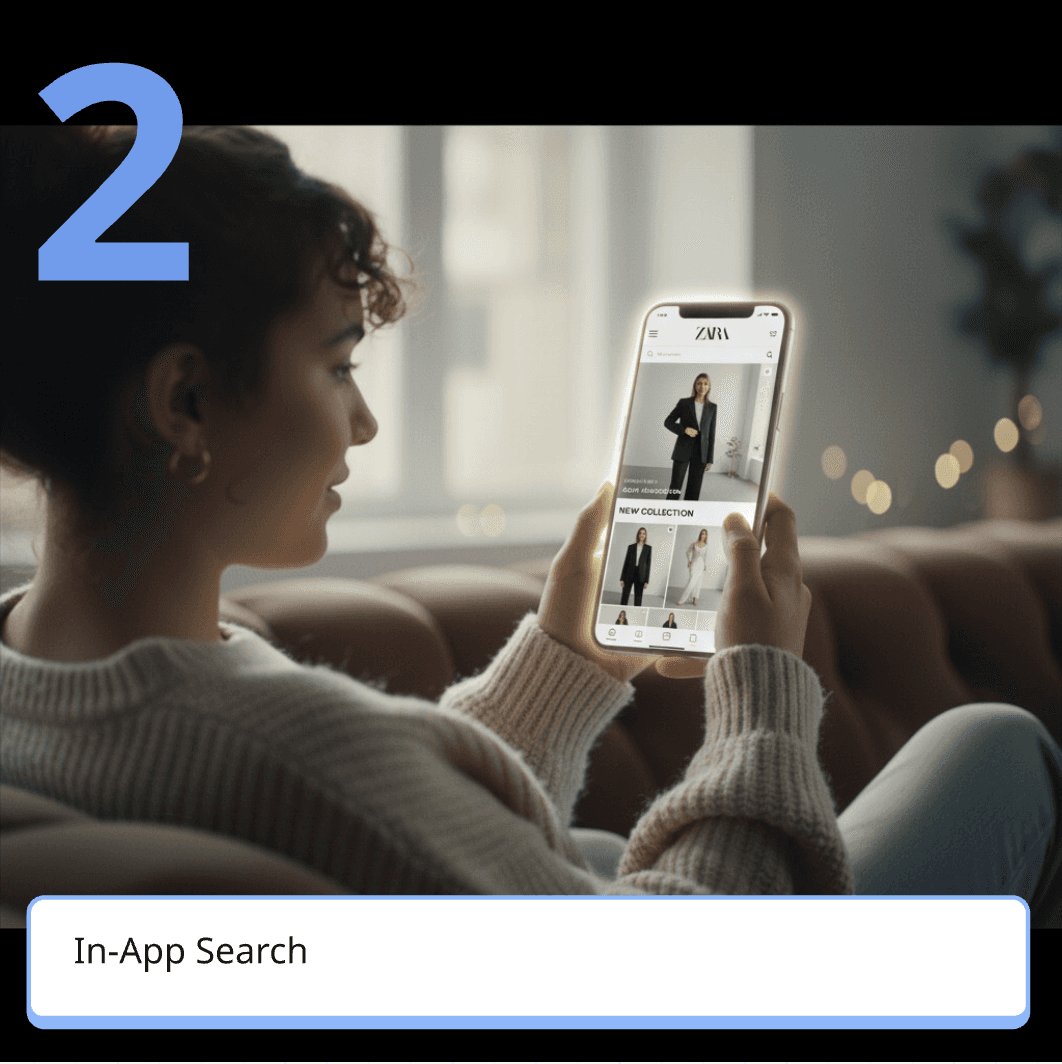
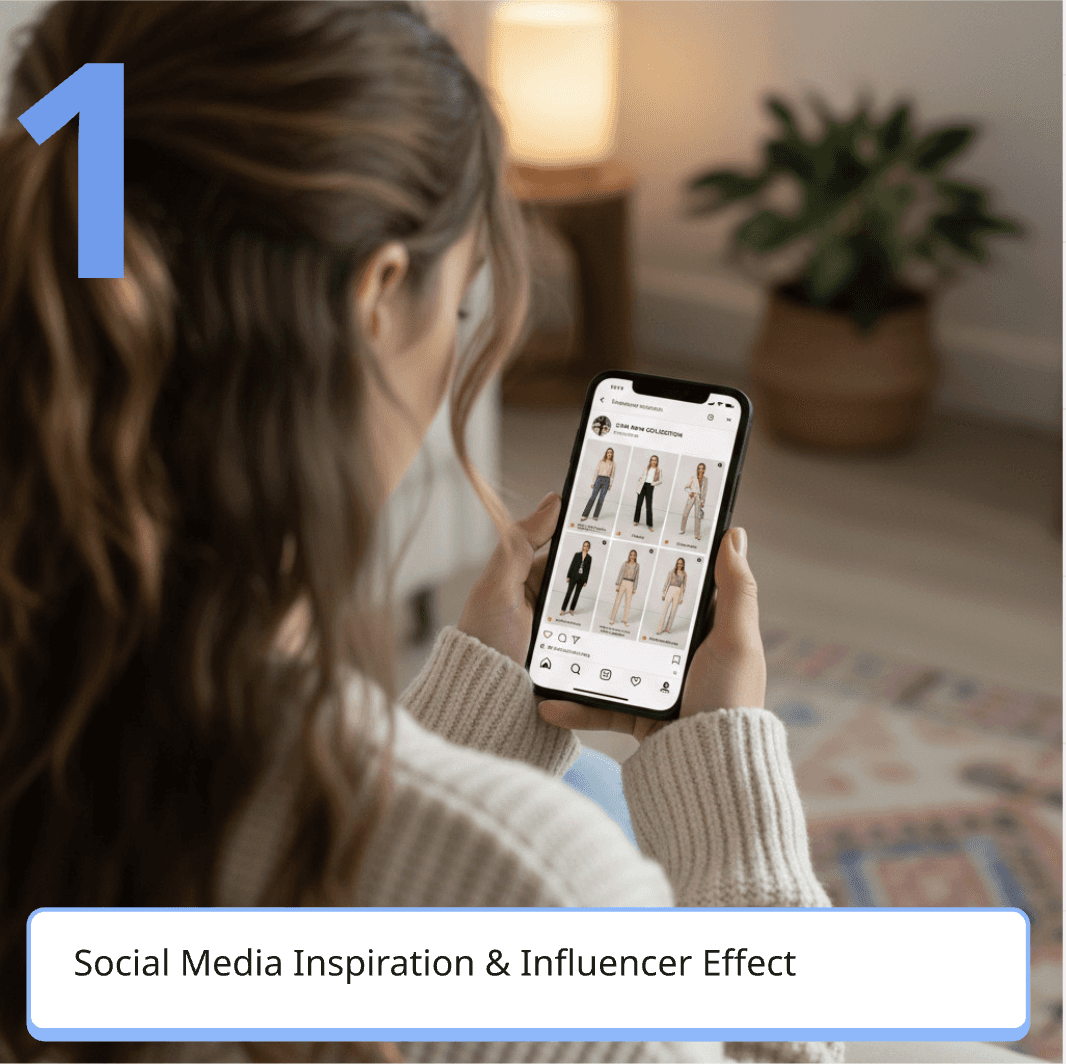
We mapped an 8-stage customer journey to better understand the end-to-end shopping experience. This allowed us to identify key touchpoints across the journey, as well as user pains, gains, behaviors, and opportunities for improvement at each stage.
Sensoria Visual
Sensoria Visual
Sensoria Visual
Sensoria Visual
Sensoria Visual
Sensoria Visual
Sensoria Visual
Sensoria Visual
Sensoria Visual
Sensoria Visual
Sensoria Visual
Sensoria Visual
Sensoria Visual
Sensoria Visual
Sensoria Visual
Sensoria Visual

Deep Dive into Critical Friction Points

Deep Dive into Critical Friction Points

Deep Dive into Critical Friction Points

Key Moments of Friction

We zoomed in on the most painful moments of the journey to identify where users experience the highest drop-off and frustration.

Zara In-Store Visit

Gains: Seeing colors and fabrics in real life.

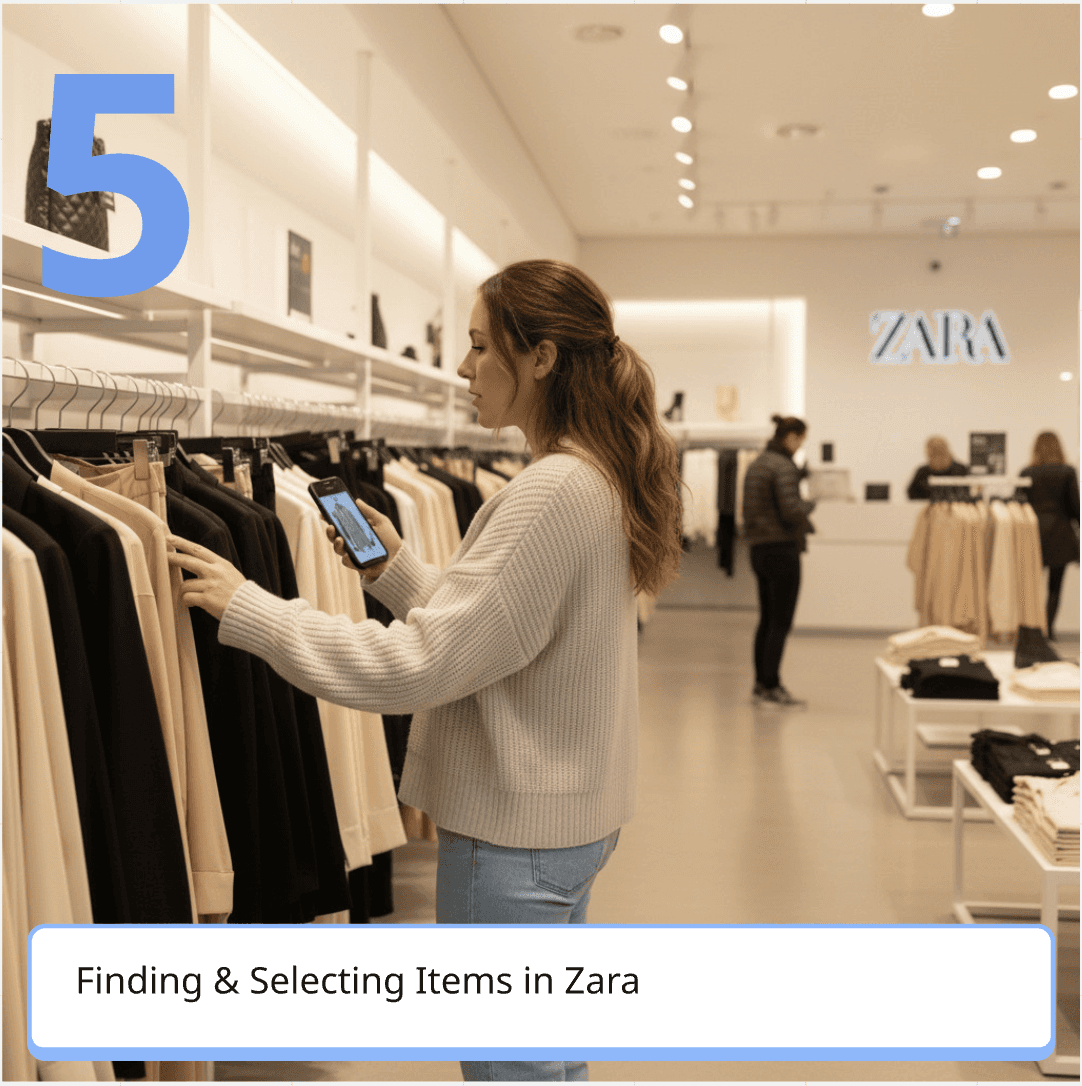
Pains: Crowded or disorganized store, difficulty finding exact items and sizes.

Opportunities: Store maps with product location, digital signage, real-time size availability (store & warehouse), and self-service screens to improve navigation and autonomy.

Finding and Selecting Items in Zara

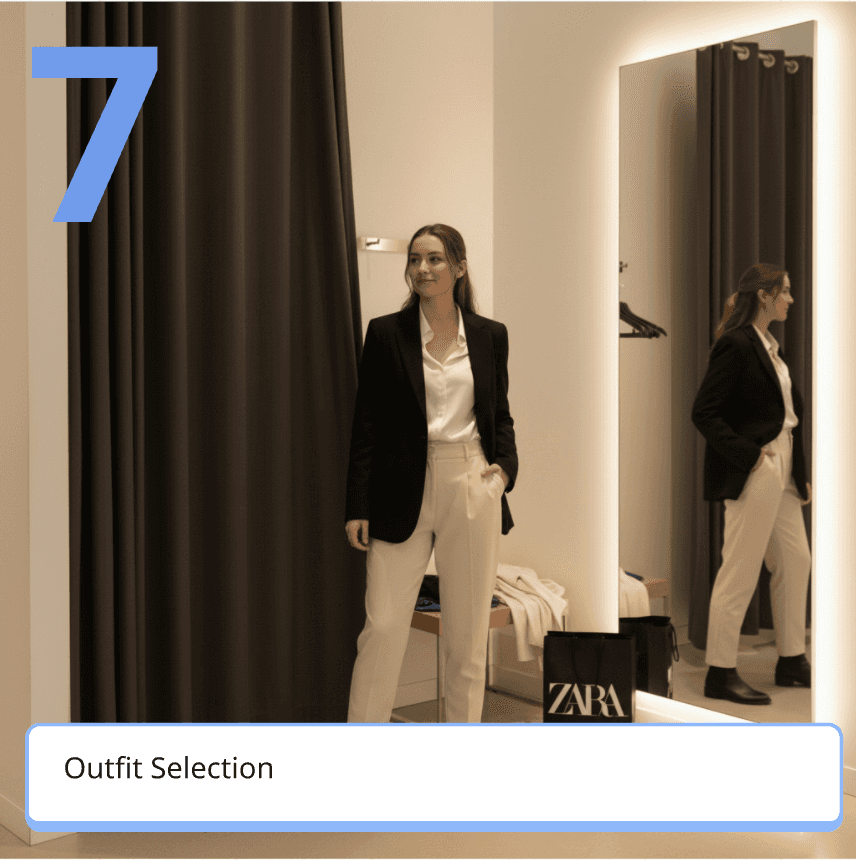
Going to Zara Fitting Rooms

Insights

1

Flow Disruption in Store Experience

Small delays across key touchpoints—such as queues, fitting rooms, checkout, or product search—break the customer’s cognitive and emotional flow. Once interrupted, the experience shifts from active shopping to passive waiting, reducing engagement and increasing the likelihood of abandonment or early store exit.

Outcome:

Broken shopping flow leading to abandonment

2

Autonomy–Assistance Balance

Customers want to complete simple tasks independently, such as searching for products, checking availability, or navigating the store. However, they still expect human assistance for physical or operational support moments, such as bringing items to the fitting room or resolving in-store needs. The experience breaks down when this balance is not well designed, either by over-relying on staff for basic discovery tasks or by failing to provide support at key service moments.

Outcome:

Misaligned assistance model

3

Seamless Channel Expectation

Users do not perceive the app and the physical store as separate touchpoints, but as part of one continuous shopping experience. They expect to move fluidly between digital and in-store interactions without losing context, information, or progress in their journey. When this continuity breaks, the experience feels fragmented, forcing users to restart or reorient themselves across channels.

Outcome:

Channel fragmentation friction

Insights

1

Flow Disruption in Store Experience

Small delays across key touchpoints—such as queues, fitting rooms, checkout, or product search—break the customer’s cognitive and emotional flow. Once interrupted, the experience shifts from active shopping to passive waiting, reducing engagement and increasing the likelihood of abandonment or early store exit.

1

Flow Disruption in Store Experience

Small delays across key touchpoints—such as queues, fitting rooms, checkout, or product search—break the customer’s cognitive and emotional flow. Once interrupted, the experience shifts from active shopping to passive waiting, reducing engagement and increasing the likelihood of abandonment or early store exit.

2

Autonomy–Assistance Balance

Customers want to complete simple tasks independently, such as searching for products, checking availability, or navigating the store. However, they still expect human assistance for physical or operational support moments, such as bringing items to the fitting room or resolving in-store needs. The experience breaks down when this balance is not well designed, either by over-relying on staff for basic discovery tasks or by failing to provide support at key service moments.

2

Autonomy–Assistance Balance

Customers want to complete simple tasks independently, such as searching for products, checking availability, or navigating the store. However, they still expect human assistance for physical or operational support moments, such as bringing items to the fitting room or resolving in-store needs. The experience breaks down when this balance is not well designed, either by over-relying on staff for basic discovery tasks or by failing to provide support at key service moments.

3

Seamless Channel Expectation

Users do not perceive the app and the physical store as separate touchpoints, but as part of one continuous shopping experience. They expect to move fluidly between digital and in-store interactions without losing context, information, or progress in their journey. When this continuity breaks, the experience feels fragmented, forcing users to restart or reorient themselves across channels.

3

Seamless Channel Expectation

Users do not perceive the app and the physical store as separate touchpoints, but as part of one continuous shopping experience. They expect to move fluidly between digital and in-store interactions without losing context, information, or progress in their journey. When this continuity breaks, the experience feels fragmented, forcing users to restart or reorient themselves across channels.

How We Solved It

Design a self-service digital touchpoint system for Zara stores that enhances customer autonomy while remaining aligned with the brand’s visual language and in-store experience.

Design a self-service digital touchpoint system for Zara stores that enhances customer autonomy while remaining aligned with the brand’s visual language and in-store experience.

Solution

We designed a self-service screen system that enables customers to locate products, check inventory, request items, join a virtual fitting room queue, and find available carts.

  • Sensoria visual showing AI glow score with skincare results.
  • Sensoria visual showing AI glow score with skincare results.
  • Sensoria visual showing AI glow score with skincare results.
  • Sensoria visual showing AI glow score with skincare results.
  • Sensoria visual showing AI glow score with skincare results.
  • Sensoria visual showing AI glow score with skincare results.
  • Sensoria visual showing AI glow score with skincare results.
  • Sensoria visual showing AI glow score with skincare results.

Accesibility

The system is fully accessible, designed with a wheelchair-friendly interaction and adjustable viewing angle. Including text resizing, high contrast mode, screen reader support, and haptic feedback, ensuring an inclusive experience for all users.

Zara

Zara

Accessibility features activated for your experience.

Accessibility features activated for your experience.

Start your shopping journey here…...

Start your shopping journey here…...

Team Weight

  • Management & Strategy Team → MST

  • Research & Design Team → RDT

  • Technical Team → TECH

  • Retail Team → RET

  • Data Team → DATA

  • Physical Systems Team → PST

0+

Estimated impact

Sales Uplift

10%

MST

10%

PST

15%

DATA

15%

RET

25%

RDT

25%

TECH

Bringing It to Life

  • Two figures on horseback under a tree against red background.
  • Two figures on horseback under a tree against red background.
  • Two figures on horseback under a tree against red background.
  • Two figures on horseback under a tree against red background.
  • Two figures on horseback under a tree against red background.
  • Two figures on horseback under a tree against red background.

The outcome

01

Fitting Room Queue Reduction & Virtual Queueing

Virtual queue system that allows customers to join the fitting room line from the app or in-store screens, with real-time updates on availability. Users receive notifications when their turn is approaching, while in-store displays show live queue status

02

Real-Time Inventory Tracking & Smart In-Store Routing

Real-time digital store map synced with inventory, where customers can save products, locate them easily, and follow guided in-store routes to find what they need faster. QR points throughout the store provide instant access to the experience.

03

On-Demand Item Requests

Simple system for requesting sizes or colors in real time, sending notifications to staff and showing request status updates until the item is delivered to the fitting room.

04

Cart & Basket Finder

We added tracking to carts and baskets, showing their real-time location on the store map so customers can quickly find the nearest available ones in the app.