Navify

Project

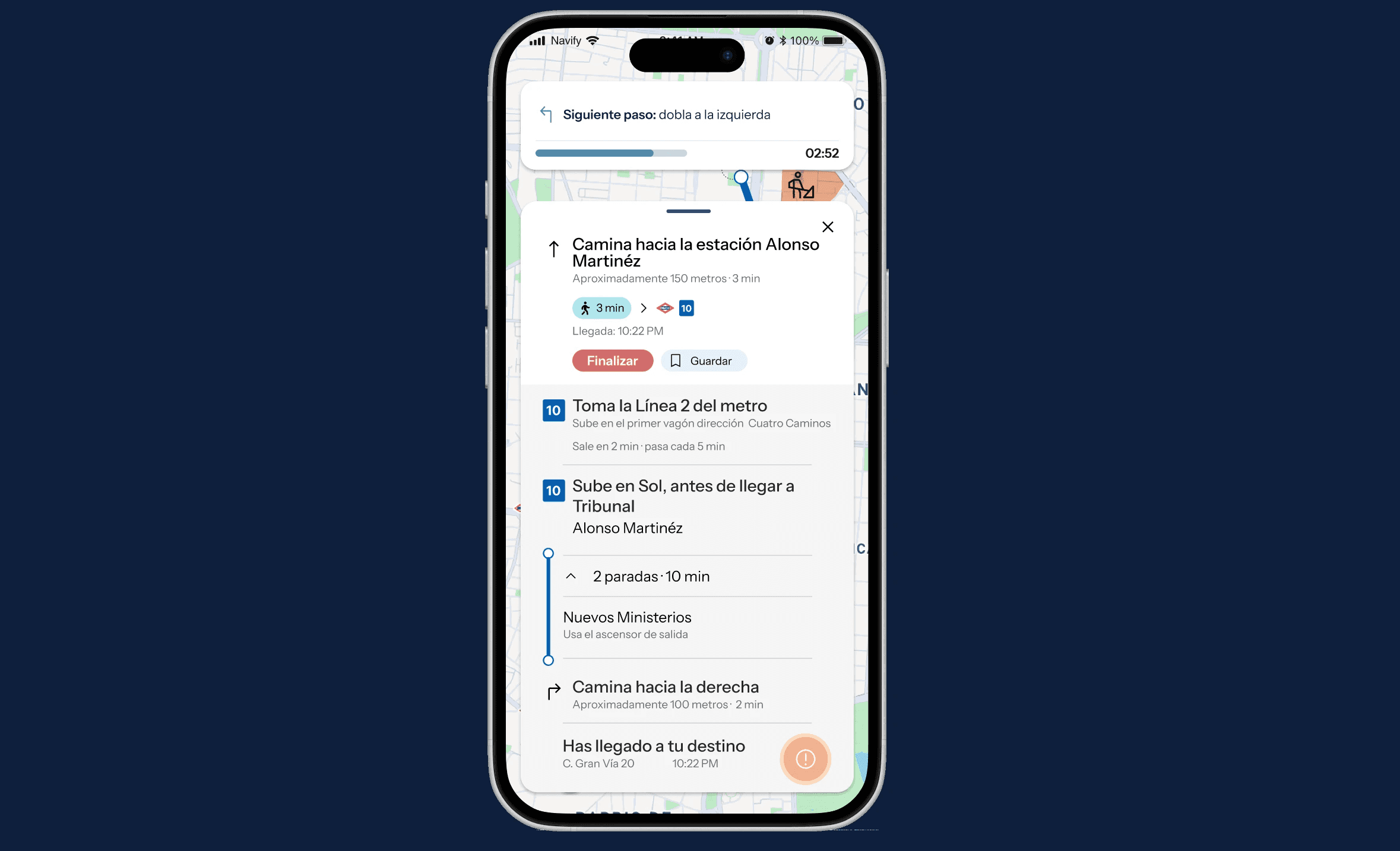
Navify is a service that reimagines urban mobility for autistic people, making everyday travel more predictable, accessible, and less overwhelming while supporting caregivers throughout the journey.

Industria

Mobility app

Rol

Product Designer

your name here
your name here

Problem

Imagine moving through a city that feels unpredictable at every step, where sound, crowd and change don’t just pass by, but hit all at once. For many autistic people in Madrid, everyday journeys can become moments of tension rather than freedom , where simple routes turn into overwhelming experiences that drain confidence and limit independence. For caregivers, each trip carries a quiet weight: the need to anticipate every detail, to stay alert, to constantly reassure, as if safety depends on never letting go of control..

Challenge

Make navigating Madrid feel more predictable and less overwhelming for autistic people by reducing moments of uncertainty and cognitive overload.

Part 1

Duration & Methodology

Week

1

Desk Research

Show more

Week

2

Benchmark

Show more

Week

3

User research interviews

Show more

Week

4

Workshop

Show more

Navify

Project

Navify is a service that reimagines urban mobility for autistic people, making everyday travel more predictable, accessible, and less overwhelming while supporting caregivers throughout the journey.

Industria

Mobility app

Rol

Product Designer

your name here
your name here

Problem

Imagine moving through a city that feels unpredictable at every step, where sound, crowd and change don’t just pass by, but hit all at once. For many autistic people in Madrid, everyday journeys can become moments of tension rather than freedom , where simple routes turn into overwhelming experiences that drain confidence and limit independence. For caregivers, each trip carries a quiet weight: the need to anticipate every detail, to stay alert, to constantly reassure, as if safety depends on never letting go of control..

Challenge

Make navigating Madrid feel more predictable and less overwhelming for autistic people by reducing moments of uncertainty and cognitive overload.

Part 1

Duration & Methodology

Week

1

Desk Research

Show more

Week

2

Benchmark

Show more

Week

3

User research interviews

Show more

Week

4

Workshop

Show more

Navify

Project

Navify is a service that reimagines urban mobility for autistic people, making everyday travel more predictable, accessible, and less overwhelming while supporting caregivers throughout the journey.

Industria

Mobility app

Rol

Product designer

your name here

Problem

Imagine moving through a city that feels unpredictable at every step, where sound, crowd and change don’t just pass by, but hit all at once. For many autistic people in Madrid, everyday journeys can become moments of tension rather than freedom , where simple routes turn into overwhelming experiences that drain confidence and limit independence.


For caregivers, each trip carries a quiet weight: the need to anticipate every detail, to stay alert, to constantly reassure, as if safety depends on never letting go of control..

Challenge

Make navigating Madrid feel more predictable and less overwhelming for autistic people by reducing moments of uncertainty and cognitive overload.

Part 1

Duration & Methodology

Week

1

Desk Research

Show more

Week

2

Benchmark

Show more

Week

3

User research interviews

Show more

Week

4

Workshop

Show more

Inside the experience

Over several weeks, we explored the lived experience of navigating cities through research, interviews, benchmarking, and co-creation sessions. What emerged was a clear disconnect between how urban mobility systems are designed and what neurodivergent people need in order to feel grounded, confident, and in control while moving through the city.

This project focuses on autistic adults with Level 1 Autism Spectrum Disorder (ASD), individuals who can generally navigate daily life independently, yet still experience meaningful challenges related to sensory overload, anxiety, and the unpredictability of public transportation. These were some of the most striking insights that first captured our attention, helping us define and ground the problem space we set out to explore (see data below)

0k

0k

Autistic people navigate everyday life in Madrid

60%

60%

Sensory hypersensitivity affects up to 96% of autistic people.

50%

50%

For 95% of neurodivergent individuals, anxiety is a barrier to using public transport regularly.

Who we learned from

Who we learned from

image

People Level 1 ASD

We spoke with People Level 1 ASD to gain a deeper understanding of what their everyday journeys through the city feel like.

image

Caregivers

image

Autisim Specialists

image

People Level 1 ASD

We spoke with People Level 1 ASD to gain a deeper understanding of what their everyday journeys through the city feel like.

image

Caregivers

Crafting iconic legacies through strategic and elegant design.

image

Autisim Specialists

Elevating digital presence through modern and intuitive design.

In their own words

In their own words

Asociación APANAS

“Not knowing whether the bus has already gone or if it’s still 20 minutes away is what triggers anxiety.”

Manuel Sanchez, Level 1 ASD

“Communication between neurotypical and autistic people is like using two different software programs.”

Micaela Ferder, Level 1 ASD

“If everything is going well, I function well, but if there’s a technical issue and I have to interact or ask for help, I shut down.”

Insights

1

When the Unexpected Takes Over

When the system fails, the absence of an obvious alternative can trigger immediate cognitive paralysis for literal thinkers.

2

The Unfiltered City

Without a way to filter sensory input, everyday urban environments can quickly become overwhelming, draining both physical and mental energy energy long before the destination is reached.

3

Lost in translation

Mobility systems often communicate through implicit signals and abstract information, creating uncertainty for people who interpret information literally.

bg-pattern

Part 2

Shaping the solution

Shaping the solution

Building on the research, we began turning insights into tangible experiences through user flows, information architecture, brand strategy, and visual identity. Each round of concept testing and user feedback helped us refine our thinking, resulting in a navigation experience grounded in users' needs, expectations, and everyday behaviors.

/01

AI Prototype

Instead of waiting for the product to exist, we used AI to imagine it. Creating a prototype that made the experience visible and opened the door to exploring its key interactions while the project was still in development.

/02

Concept Testing

The team shared the concept and prototype with potential users and stakeholders to explore initial reactions, perceived value, and areas of concern. These sessions surfaced what resonated most and highlighted where the experience still needed refinement.

/04

User Flows and AI

We defined user flows and structured the information architecture to clarify how users navigate through the product and access key features. This helped create a clear and predictable structure that reduces cognitive load and supports users throughout their journey.

/03

Validation Interviews

Further conversations with neurodivergent individuals, caregivers, and professionals to revisit our assumptions and gather feedback on the proposed experience. Their perspectives pushed us to question our initial direction and refine key features and interactions.

/05

Brand Identity

To support Navify’s goal of reducing uncertainty and enabling autonomy, we designed a brand and visual system through a sensory-conscious lens. This approach led to the use of calming colors and low-stimulation elements, creating a safer and more approachable experience for neurodivergent users.

/06

Final Prototype

The final prototype brought together the different layers of the experience into a cohesive journey

/01

AI Prototype

Instead of waiting for the product to exist, we used AI to imagine it. Creating a prototype that made the experience visible and opened the door to exploring its key interactions while the project was still in development.

/02

Concept Testing

The team shared the concept and prototype with potential users and stakeholders to explore initial reactions, perceived value, and areas of concern. These sessions surfaced what resonated most and highlighted where the experience still needed refinement.

/04

User Flows and AI

We defined user flows and structured the information architecture to clarify how users navigate through the product and access key features. This helped create a clear and predictable structure that reduces cognitive load and supports users throughout their journey.

/03

Validation Interviews

Further conversations with neurodivergent individuals, caregivers, and professionals to revisit our assumptions and gather feedback on the proposed experience. Their perspectives pushed us to question our initial direction and refine key features and interactions.

/05

Brand Identity

To support Navify’s goal of reducing uncertainty and enabling autonomy, we designed a brand and visual system through a sensory-conscious lens. This approach led to the use of calming colors and low-stimulation elements, creating a safer and more approachable experience for neurodivergent users.

/06

Final Prototype

The final prototype brought together the different layers of the experience into a cohesive journey

The outcome

Three key insights

Users autonomy

Users don’t want control taken away from them—they want support that helps them stay independent and make their own decisions.

Familiarity and integration

The solution should align with existing user behaviors, integrating naturally into how people already navigate and interact, without requiring new learning or habits.

Reduced Cognitive Load

The experience should feel calm and easy to process, reducing pressure by avoiding complexity and time-sensitive interactions.

Designed for...

Designing from insight

Designing from insight

services image
services image

/01

We learned that the journey begins long before departure. This led us to create emotional check-ins and preparation tools that help users start with greater confidence and peace of mind.

services image
services image

/01

We learned that the journey begins long before departure. This led us to create emotional check-ins and preparation tools that help users start with greater confidence and peace of mind.

services image
services image

/02

We discovered that it's not the disruption itself, but the uncertainty that follows, which creates cognitive blockage. To address this, we designed proactive route support and alternative guidance.

services image
services image

/02

We discovered that it's not the disruption itself, but the uncertainty that follows, which creates cognitive blockage. To address this, we designed proactive route support and alternative guidance.

services image
services image

/03

In moments of distress, decision-making becomes harder. To address this, we designed an always-available crisis support system to provide immediate support when it’s needed.

services image
services image

/03

In moments of distress, decision-making becomes harder. To address this, we designed an always-available crisis support system to provide immediate support when it’s needed.

services image
services image

/04

We learned that traditional navigation tools can contribute to sensory overload, so we designed a more mindful, sensory-aware navigation experience.

services image
services image

/04

We learned that traditional navigation tools can contribute to sensory overload, so we designed a more mindful, sensory-aware navigation experience.

services image
services image

/01

We learned that the journey begins long before departure. This led us to create emotional check-ins and preparation tools that help users start with greater confidence and peace of mind.

services image
services image

/02

We discovered that it's not the disruption itself, but the uncertainty that follows, which creates cognitive blockage. To address this, we designed proactive route support and alternative guidance.

services image
services image

/03

In moments of distress, decision-making becomes harder. To address this, we designed an always-available crisis support system to provide immediate support when it’s needed.

services image
services image

/04

We learned that traditional navigation tools can contribute to sensory overload, so we designed a more mindful, sensory-aware navigation experience.

How it comes together

How it comes together

Navify is an inclusive mobility app designed to reduce uncertainty and ease cognitive, sensory, and emotional overload during urban journeys. It helps people navigate cities with greater autonomy, confidence, and predictability through personalized guidance, sensory-aware design, and proactive support.
How it comes together

How it comes together

How it comes together

How it comes together

What we achieved

What we achieved

01

Onboarding

Mobility is experienced differently by everyone, which makes one-size-fits-all solutions ineffective. Navify responds by learning users’ sensory preferences and support needs from the very beginning, shaping a more personalized experience from the start.

02

Home

Uncertainty often starts before the journey even begins. The home screen is designed as a moment to pause, reflect, and proactively access support before setting off.

03

Crisis Buttom

In moments of distress, users reported freezing and finding it difficult to communicate their needs. To support this, the experience reduces the need for decision-making by surfacing immediate actions and personalized coping tools.

04

Map

The challenge with traditional navigation is not just information, but unpredictability. Navify addresses this by designing for sensory needs and predictability, while incorporating live updates from users to reflect real conditions.