Alerta
Project
Service design project addressing climate emergencies by integrating real-time information and support systems to improve citizen response and reduce uncertainty during critical events.
Industria
Civic Tech
Smart Cities
Government Services
Rol
Product Designer
Problem
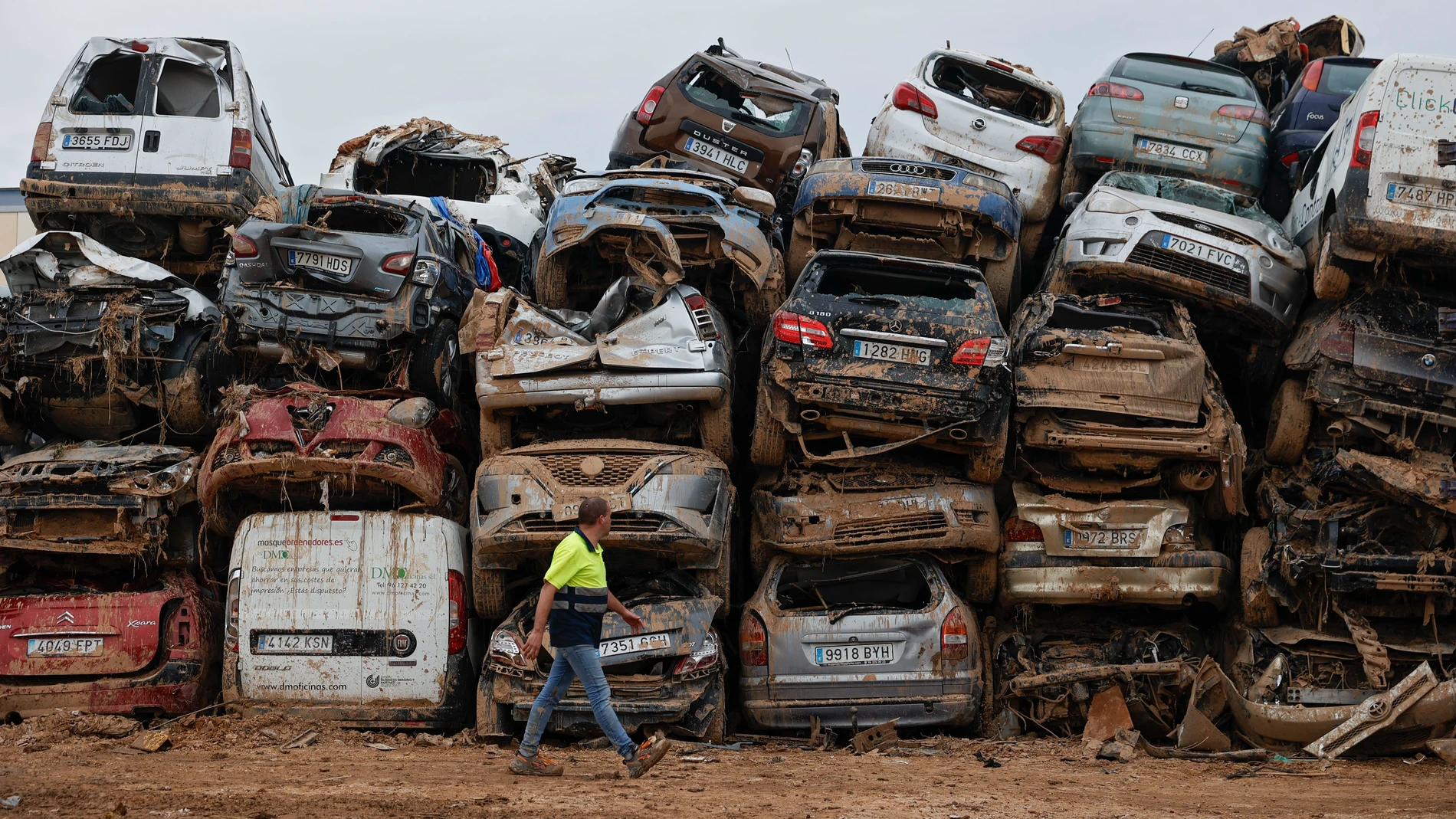
Extreme climate events are becoming more frequent, yet information remains fragmented and difficult to act on. There is no clear system that guides people on what to do before, during, and after a crisis, leading to confusion, uncertainty, and improvised decisions. The challenge is not the lack of data, but the absence of a system that turns it into action.
Challenge
Turn fragmented climate information into clear, actionable guidance that supports people through every stage of a crisis.
Duration & Methodology
Week
1
Desk Research
Show more
Week
2
User research interviews
Show more
Week
4
Defining user archetypes
Show more
Week
4
Ideation & prioritization
Show more
Week
5
AI-supported insight validation
Show more
Week
6
Design proposal
Where the problem begins
Over several weeks, we explored how people experience and respond to climate emergencies through research, interviews, benchmarking, and analysis of existing emergency systems. What emerged was a clear gap between how emergency information systems are designed and what people actually need in moments of crisis in order to feel informed, prepared, and able to act with confidence.
This project focuses on climate-related emergencies in Spain, particularly in regions with high recurrence of extreme weather events such as Valencia, where floods and storms have become increasingly severe and frequent. It examines how people aged 15 to 59—including families, older adults, and rural communities—access and interpret critical information before, during, and after a crisis, often through fragmented digital platforms and official alerts.
50+
50+
Lives were lost in the Valencia DANA.
0%
0%
Unusually extreme rainfall events, intensified by human-driven climate
What we uncovered
From our desk research and interviews, a clear set of human patterns emerged in how people experience climate emergencies. These findings reveal key emotional and behavioral needs that current systems fail to fully address.
Protecting what matters most
People are primarily concerned about the safety of their family and friends.
2.When systems don’t respond
There is a perceived lack of institutional support, with delays or absence of response from authorities.
Uncertainty prevents action
Many people fail to take preparatory action because information arrives too late or they are unsure what to do.
4.Clarity over complexity
They seek accessible solutions that provide clear, simple, and actionable information.
Emerging Patterns
From broad insights to specific patterns
Refining insights into key focus areas
Emerging Patterns
From broad insights to specific patterns
Refining insights into key focus areas
Love drives action
Action is often driven by one priority above all else: protecting loved ones during climate emergencies.
Information paralysis
Uncertainty and misinformation amplify fear and can leave people unable to act.
Feeling left behind
A perceived sense of abandonment leads to growing distrust in institutions.
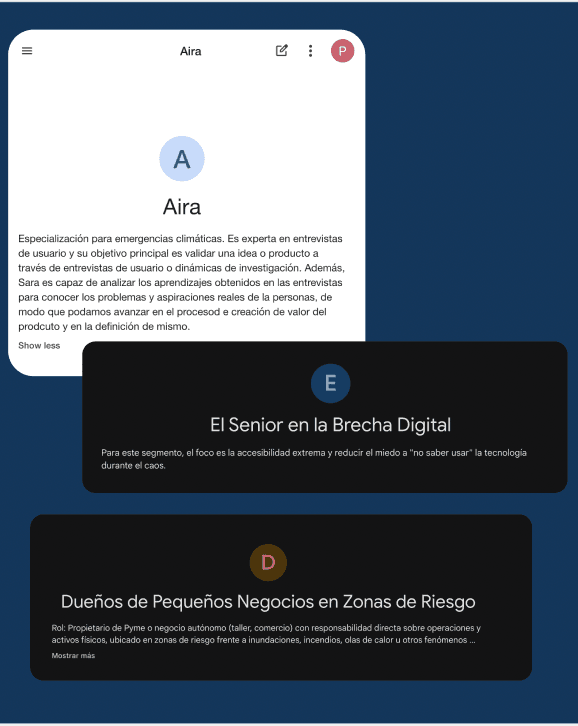
To deepen and scale our research, we developed a Research GEM—an AI agent designed to simulate and analyze interview responses across user segments. It allowed us to identify behavioral patterns, emotional responses, and decision-making under stress at scale.
Extending research through AI
Simulating interviews
The Researcher GEM is a synthetic research agent designed to generate structured interviews across defined user segments. It simulates realistic questioning to explore user experiences, behaviors, and decision-making patterns.
Insight extraction
It also analyzes interview responses at scale, identifying recurring themes, emotional triggers, and behavioral insights that help deepen understanding beyond individual conversations.

Segment-based simulation
A dedicated GEM is created for each user segment, allowing for tailored interview simulations that reflect realistic behaviors and contexts. This approach ensures that each group is explored with specificity and relevance.
Behavior at scale
Each GEM conducts up to 30 simulated interviews, surfacing patterns in tasks, fears, and decision-making under stress. This enables a deeper understanding of behavioral differences across contexts at scale.

What guided our decisions
These insights directly informed our design principles, translating research findings into clear guiding rules that shaped the final experience.
01
Always informed
Because clear, verified, and real-time information reduces uncertainty, builds trust, and helps save lives.
02
With you every step of the way
Because emergencies don't begin or end with the event itself. Support should be available before, during, and after the crisis.
03
Safety first
Because the priority is to protect lives by enabling clear decisions and safe environments.
04
No one left behind
Because everyone should have access to information and resources, regardless of age, language, or condition.
Alerta
Project
Service design project addressing climate emergencies by integrating real-time information and support systems to improve citizen response and reduce uncertainty during critical events.
Industria
Civic Tech
Smart Cities
Government Services
Rol
Product Designer
Problem
Extreme climate events are becoming more frequent, yet information remains fragmented and difficult to act on. There is no clear system that guides people on what to do before, during, and after a crisis, leading to confusion, uncertainty, and improvised decisions. The challenge is not the lack of data, but the absence of a system that turns it into action.
Challenge
Turn fragmented climate information into clear, actionable guidance that supports people through every stage of a crisis.
Duration & Methodology
Week
1
Desk Research
Show more
Week
2
User research interviews
Show more
Week
4
Defining user archetypes
Show more
Week
4
Ideation & prioritization
Show more
Week
5
AI-supported insight validation
Show more
Week
6
Design proposal
Alerta
Project
Service design project addressing climate emergencies by integrating real-time information and support systems to improve citizen response and reduce uncertainty during critical events.
Industria
Civic Tech
Smart Cities
Government Services
Rol
Product designer
Problem
Extreme climate events are becoming more frequent, yet information remains fragmented and difficult to act on. There is no clear system that guides people on what to do before, during, and after a crisis, leading to confusion, uncertainty, and improvised decisions. The challenge is not the lack of data, but the absence of a system that turns it into action.
Challenge
Turn fragmented climate information into clear, actionable guidance that supports people through every stage of a crisis.
Duration & Methodology
Week
1
Desk Research
Show more
Week
2
User research interviews
Show more
Week
4
Defining user archetypes
Show more
Week
4
Ideation & prioritization
Show more
Week
5
AI-supported insight validation
Show more
Week
5
Design proposal
Where the problem begins
Over several weeks, we explored how people experience and respond to climate emergencies through research, interviews, benchmarking, and analysis of existing emergency systems. What emerged was a clear gap between how emergency information systems are designed and what people actually need in moments of crisis in order to feel informed, prepared, and able to act with confidence.
This project focuses on climate-related emergencies in Spain, particularly in regions with high recurrence of extreme weather events such as Valencia, where floods and storms have become increasingly severe and frequent. It examines how people aged 15 to 59—including families, older adults, and rural communities—access and interpret critical information before, during, and after a crisis, often through fragmented digital platforms and official alerts.
50+
50+
Lives were lost in the Valencia DANA.
0%
0%
Unusually extreme rainfall events, intensified by human-driven climate
How it comes together
ALERTA redefines how people navigate climate emergencies in Spain. By centralizing information, resources, and human support, it enables clearer and more coordinated responses before, during, and after extreme weather events.
Three ways it helps
01
AI & Expert Guidance
Aira is an intelligent assistant that provides clear, real-time guidance in moments of uncertainty. It helps users make sense of complex or overwhelming situations by turning information into simple, actionable steps. Through a natural, conversational interface, it keeps users informed, oriented, and supported when they need it most.
02
Dynamic Maps
Dynamic maps provide real-time information on safe routes and risk zones during emergencies. They offer interactive navigation with evacuation paths adapted to the user’s specific location and context. This helps people move with greater clarity and confidence by highlighting what areas to avoid and which routes are safest at any given moment.
03
Crisis Buttom
A coordinated community that connects education, support, and citizen action into a single system. It helps people understand how to respond to different alerts, access local support, and organize assistance in a clear and efficient way without creating confusion. The system is reinforced by local volunteers and the ALERTA community, which drives immediate response, workshops, and recovery actions.
Bringing the solution to life


What we uncovered
From our desk research and interviews, a clear set of human patterns emerged in how people experience climate emergencies. These findings reveal key emotional and behavioral needs that current systems fail to fully address.
Protecting what matters most
People are primarily concerned about the safety of their family and friends.
2.When systems don’t respond
There is a perceived lack of institutional support, with delays or absence of response from authorities.
Uncertainty prevents action
Many people fail to take preparatory action because information arrives too late or they are unsure what to do.
4.Clarity over complexity
They seek accessible solutions that provide clear, simple, and actionable information.
Emerging Patterns
From broad insights to specific patterns
Refining insights into key focus areas
Love drives action
Action is often driven by one priority above all else: protecting loved ones during climate emergencies.
Information paralysis
Uncertainty and misinformation amplify fear and can leave people unable to act.
Feeling left behind
A perceived sense of abandonment leads to growing distrust in institutions.
To deepen and scale our research, we developed a Research GEM—an AI agent designed to simulate and analyze interview responses across user segments. It allowed us to identify behavioral patterns, emotional responses, and decision-making under stress at scale.
Extending research through AI
Simulating interviews
The Researcher GEM is a synthetic research agent designed to generate structured interviews across defined user segments. It simulates realistic questioning to explore user experiences, behaviors, and decision-making patterns.
Simulating interviews
The Researcher GEM is a synthetic research agent designed to generate structured interviews across defined user segments. It simulates realistic questioning to explore user experiences, behaviors, and decision-making patterns.
Insight extraction
It also analyzes interview responses at scale, identifying recurring themes, emotional triggers, and behavioral insights that help deepen understanding beyond individual conversations.
Insight extraction
It also analyzes interview responses at scale, identifying recurring themes, emotional triggers, and behavioral insights that help deepen understanding beyond individual conversations.
Segment-based simulation
A dedicated GEM is created for each user segment, allowing for tailored interview simulations that reflect realistic behaviors and contexts. This approach ensures that each group is explored with specificity and relevance.
Segment-based simulation
A dedicated GEM is created for each user segment, allowing for tailored interview simulations that reflect realistic behaviors and contexts. This approach ensures that each group is explored with specificity and relevance.
Behavior at scale
Each GEM conducts up to 30 simulated interviews, surfacing patterns in tasks, fears, and decision-making under stress. This enables a deeper understanding of behavioral differences across contexts at scale.
Behavior at scale
Each GEM conducts up to 30 simulated interviews, surfacing patterns in tasks, fears, and decision-making under stress. This enables a deeper understanding of behavioral differences across contexts at scale.
What guided our decisions
These insights directly informed our design principles, translating research findings into clear guiding rules that shaped the final experience.
01
Always informed
Because clear, verified, and real-time information reduces uncertainty, builds trust, and helps save lives.
02
With you every step of the way
Because emergencies don't begin or end with the event itself. Support should be available before, during, and after the crisis.
03
Safety first
Because the priority is to protect lives by enabling clear decisions and safe environments.
04
No one left behind
Because everyone should have access to information and resources, regardless of age, language, or condition.
How it comes together
ALERTA redefines how people navigate climate emergencies in Spain. By centralizing information, resources, and human support, it enables clearer and more coordinated responses before, during, and after extreme weather events.
Three ways it helps
01
AI & Expert Guidance
Aira is an intelligent assistant that provides clear, real-time guidance in moments of uncertainty. It helps users make sense of complex or overwhelming situations by turning information into simple, actionable steps. Through a natural, conversational interface, it keeps users informed, oriented, and supported when they need it most.
02
Dynamic Maps
Dynamic maps provide real-time information on safe routes and risk zones during emergencies. They offer interactive navigation with evacuation paths adapted to the user’s specific location and context. This helps people move with greater clarity and confidence by highlighting what areas to avoid and which routes are safest at any given moment.
03
Crisis Buttom
A coordinated community that connects education, support, and citizen action into a single system. It helps people understand how to respond to different alerts, access local support, and organize assistance in a clear and efficient way without creating confusion. The system is reinforced by local volunteers and the ALERTA community, which drives immediate response, workshops, and recovery actions.
Bringing the solution to life
The outcome
Before the emergency
Through education, Aira’s guidance, and real-time risk-aware maps, users are able to understand what is happening and how to prepare in advance. As a result, people feel more informed, calm, and ready to respond appropriately when an alert occurs.
During the emergency
With real-time information, SOS connectivity even without network access, and support from local volunteers, users are able to navigate uncertainty with greater clarity and assistance. This leads to safer movement, reduced chaos, and more confident decision-making under pressure.
After the emergency
Through coordinated community support, continuous access to verified information via Aira, and local recovery initiatives, users remain supported beyond the crisis. As a result, recovery becomes faster, more organized, and more efficient for both individuals and communities.
The outcome
Before the emergency
Through education, Aira’s guidance, and real-time risk-aware maps, users are able to understand what is happening and how to prepare in advance. As a result, people feel more informed, calm, and ready to respond appropriately when an alert occurs.
During the emergency
With real-time information, SOS connectivity even without network access, and support from local volunteers, users are able to navigate uncertainty with greater clarity and assistance. This leads to safer movement, reduced chaos, and more confident decision-making under pressure.
After the emergency
Through coordinated community support, continuous access to verified information via Aira, and local recovery initiatives, users remain supported beyond the crisis. As a result, recovery becomes faster, more organized, and more efficient for both individuals and communities.